
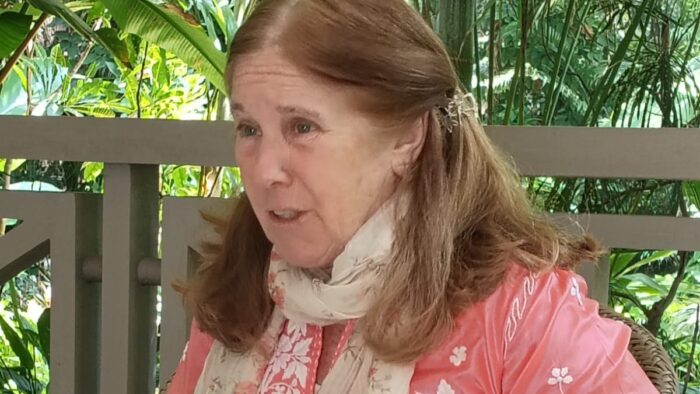
In an age marked by ecological collapse, political polarization, and moral fatigue, Dena Merriam
does not speak of revolution in the language of anger. She speaks instead of inner work. Of
clearing one’s own shadows. Of learning to respond, rather than react.
Merriam, best known for The Untold Story of Sita, never intended to return to the Ramayana
world. After completing a novel set in Tibet and beginning work on a futuristic book, she found
herself unexpectedly drawn back - not by research or planning, but by a dream.
“Sita appeared to me,” she says simply. “And this book came to me. The teachings were for me
personally, as much as they were for the reader.”
Unlike her earlier work, which focused on reclaiming Sita’s outer narrative from centuries of
distortion, her new book Sita's Yoga: The Yoga of Awakening, turns inward. Set after the war in Lanka and voiced through a village woman of deep spiritual maturity, it explores what Merriam calls “the yoga of daily life” - how
to live in line with dharma amid chaos, injustice, and planetary crisis.
Ravana, she explains, was not merely a mythic antagonist but a force - one defined by greed,
arrogance, and domination. “Those same forces exist today,” she says. “We see greed consuming
the planet. We see leaders oppressing not only people, but life itself.”
The question, then, is not whether evil exists, but how it is to be countered.
Each chapter of the book takes up a different inner discipline: non-reaction, non-judgment,
conscious response. The premise is simple but demanding, the outer world is a manifestation
of the collective, and the collective is shaped by individual consciousness. “We all contribute,”
Merriam notes. “So, the work has to begin within.”
This idea resonates strongly with both ancient Indic philosophy and modern psychology. Where
the Yoga Sutras speak of kleshas, contemporary thinkers speak of shadow work. For Merriam,
these are simply different languages describing the same inner terrain.
She believes humanity is at the edge of a shift - one that must happen if we are to survive.
“We’re moving away from a purely material consciousness,” she says, “and toward an
understanding of the spiritual nature of reality.” Younger generations, she observes, may not use
traditional religious language, but they are searching for the same truths. “The rishis were
scientists,” she reminds us. “There was no religion then. It was simply the way things are.”
Central to the book is Sita’s method of teaching - one that feels particularly relevant today.
“She doesn’t scold. She doesn’t say, ‘You’re wrong,’” Merriam explains. “She teaches through
life itself.”
A challenge arises. A situation provokes anger or fear. That moment is the teaching.
“We either respond unconsciously, repeating old patterns,” she says, “or we see it as a divine test
and respond consciously.” At one point in the book, Sita’s attendant Soma observes, “Sita did
not come to reveal who she is. She came to reveal who you are.”
This philosophy extends to Merriam’s understanding of free will and karma. While karma shapes
the conditions of our lives, she believes free will lies in how we meet those conditions. “We
always have a choice,” she says. “We can react with anger or resentment, or we can ask, ‘What
am I meant to learn from this?’”
She is clear that this is not abstract theory. While writing chapters on non-reaction and non-
judgment, she found herself struggling deeply. “Conditions in my country are very difficult right
now,” she admits. “And it’s very easy to fall into judgment - even self-righteous judgment.”
What shifted her perspective was seeing harmful actions not as reasons for hatred, but as seeds of
future suffering for those who commit them. “That awakened compassion,” she says. “Because
karma is ultimate justice. The universe doesn’t need my anger to correct imbalance.”
This does not mean withdrawal from the world. Merriam speaks at length about the tension
between inner stillness and outer action - a tension faced by activists, writers, and political
thinkers alike. “We must oppose injustice,” she insists. “But without losing our inner center.”
Even Sita, she reminds us, experienced righteous anger when she witnessed vast inequality in
Lanka. Yet she had to be brought back into balance. “The challenge,” Merriam says, “is to act
without hatred - to resist injustice without becoming it.”
The book also deepens the relationship between Rama and Sita, portraying them not as separate
forces but as complementary expressions of the same truth - much like Shiva and Shakti.
“Wisdom and love are the two pillars that hold up the universe,” Merriam says.
In one story, Sita demonstrates that wisdom without love is incomplete. Later, Rama opens a
sage’s heart so that he may experience divine love directly. “Love is not emotion,” Merriam
emphasizes. “It is a state of being.”
This, she believes, is where modern society is profoundly unbalanced. Even in global
institutions, she has been told that the word love is too soft to be used seriously. “You can say
compassion,” she says with a wry smile, “but not love.”
Yet love - as karuṇā, as presence, as divine magnetism - is precisely what the world lacks.
Merriam is particularly critical of the idea that women must adopt traditionally male models of
power to be effective. “That was never the purpose,” she says. “What women are meant to bring
is balance.”
Through her Global Peace Initiative of Women, she witnessed something unexpected: men came
in equal numbers, not to lead, but because they were “hungry for this energy” - for a way of
being that integrates strength with care.
Spiritually, Merriam does not draw hard boundaries between traditions. “Shaktism and Advaita
are not separate to me,” she says. “Sometimes you are the beloved. Sometimes you merge with
the beloved. Life moves between these states.”
Today, she describes herself as “a servant of Sita, in love with Rama,” allowing her love to flow
through her and his presence to awaken within.
As for the future, Merriam is neither utopian nor dystopian. “Not Satya Yuga yet,” she says,
smiling. The coming centuries will bring immense challenges, particularly through new
technologies with vast creative and destructive potential. But she remains quietly hopeful.
“The future isn’t created for us,” she says. “We are creating it - every day, through the
consciousness we choose to embody.”
And perhaps that, she suggests, is Sita’s deepest teaching for our time.