
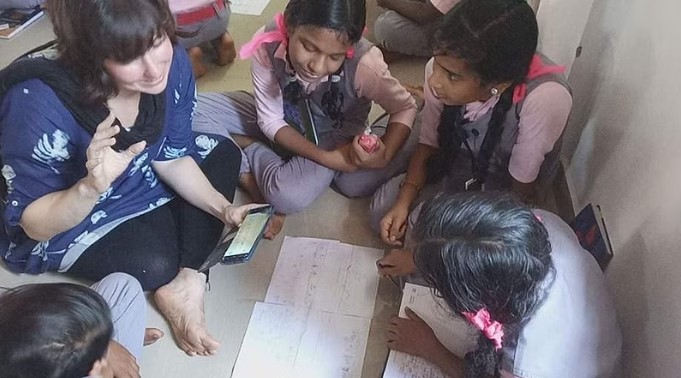
Elizabeth Keyton hosts one of the most popular Malayalam teaching programmes on social media. Her Instagram handle eli.kutty has followers all over the world wanting to learn, improve and polish their Malayalam. Elizabeth shares the story of her interest in the language and the success of her initiative with CSP.
How did a person from Georgia come to start a Malayalam teaching program on social media?
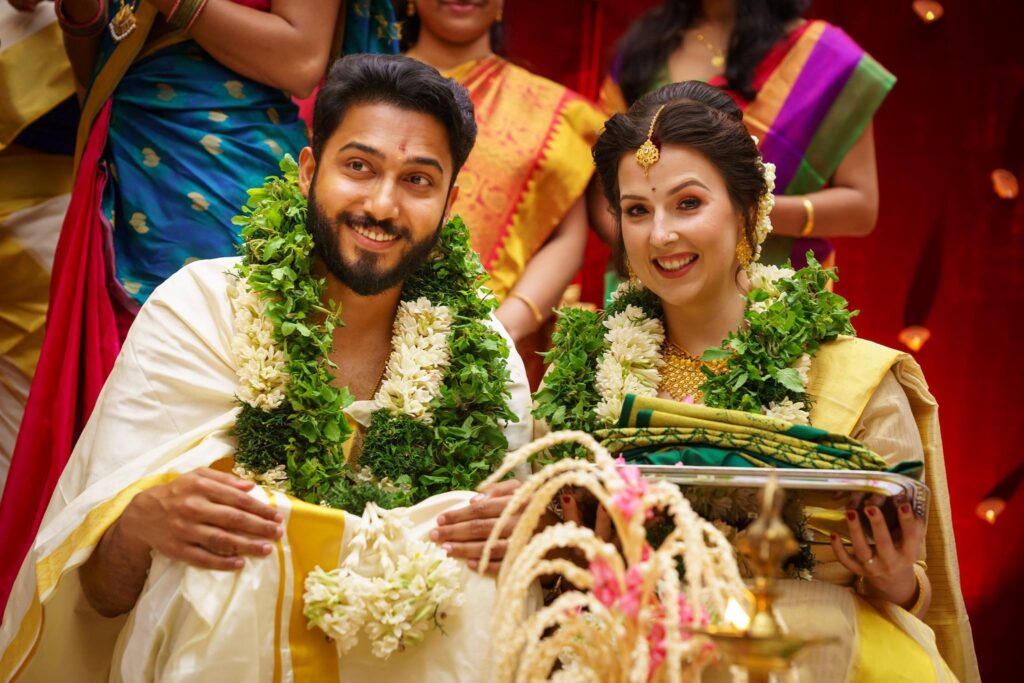
I have been teaching English as an Additional Language since 2009, and have been trained to teach languages through my degree and certificate programs. I had worked in South Korea, Texas, and NYC before coming to the UAE in 2015. The UAE, and the Gulf in general, is home to many Malayalees, so it’s no surprise I would meet Arjun there. Once we became more serious in our relationship, I decided to learn Malayalam. I think that language is very important to connecting culture and people, so it seemed like the natural thing to do when marrying into a family and blending cultures. However, Malayalam resources aren't readily available, so I had to do a lot of research, read language analyses, and go through old textbooks to learn new ideas. For me, teaching is a great way of learning, so I started making notes on an Instagram page. I made it mostly for my benefit and others who may be interested in learning, however after a year the popularity grew and I became more dedicated to making educational resources and helping others learn the language with more updated techniques and explanations.
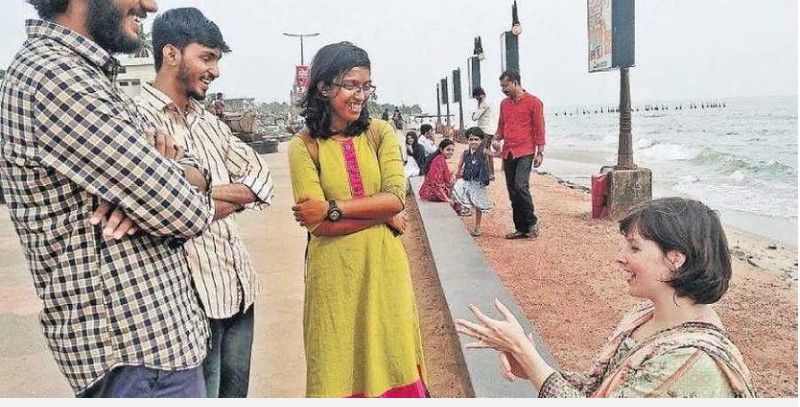
How did you decide on the name Eli Kutty for your project? What has been it's impact.
My name is Eliza, and someone once called me "Eli" for short. My Tamizh friend told me how in Tamizh (and Malayalam) it means rat, but if I added Kutty to it, it could be very cute. It was a joke name between us, and when I started my account, I used this name for it to be funny. I didn't know it would become a household name later!
Are you a linguist? Does learning languages come easily to you?
I am a language enthusiast and a teacher. I spend most of my studies on how language is acquired and techniques to help people learn. While my background was focused on teaching English, many of these ideas are easily transferable to other languages. As a child, I studied Spanish, and later spent time on Korean and Japanese. If there is the correct motivation, then learning a language can be fun, and with good resources it can be easy.
What would you attribute the success of your Malayalam teaching project to? Who are the main people wanting to learn from you? Are there not enough resources locally?
I started EliKutty on my own and my husband has been a big support. Many people assume I've learned from him directly or he has creative control on my work, but I've done a lot of things on my own, just with my curiosity and creativity leading the way. However, I have relied a lot on my tutors from italki and muthassi.in to help me stay motivated learning and improving my Malayalam. My followers are mostly Malayalees, many who are intrigued with my work and learning neat things about their language that they hadn't considered before. In my classes, I have a mix of foreigners from New Zealand, Europe, Canada, etc, as well as NRIs who are trying to get back in touch with their mother tongue.
There aren't as many resources for Malayalam as there are for other languages like Spanish, Hindi, or Japanese. Also, the current school programs favor English medium curriculum, meaning local children need to take tuitions to help them read and write Malayalam. while there is legislation to promote mother tongue education, there needs to be more allocation of resources to states to help improve and update their curriculum, as well as pedagogical standards
That being said, the Kerala government has made many wonderful initiatives like the Malayalam Mission to promote mother tongue education, as well as Malayalam class schemes for guest workers who come to Kerala for employment.
What was the hardest part of learning Malayalam. How did you manage to learn the grammar and the pronunciation? How did you translate this to your teaching?
Malayalam has a lot of unique properties that make it challenging for someone who speaks English to learn. One example are the retroflex sounds that don't exist in English. This results in 2 different L sounds ള /ല , different N sounds ന ണ , and the infamous zha/ഴ . As I teach others these sounds, I often use diagrams of the mouth to show where the tongue placement is and how the lips, teeth, and airflow all work to make these phonemes.
As for grammar, Malayalam has the feature of agglutination. This means that instead of using several words, Malayalam employs many suffixes to give an exact meaning.
Here's an example I like to use:
In Malayalam- you can see this phrase:
guhakalilekkulla yathra ഗുഹകളില്ലെകുള്ള യാത്ര
you can break down the word like this:
guha-kal-il-lekku -lla yathra ഗുഹ-കളി-ല്ലെകു-ള്ള
(cave-plural-direction-toward-adjective) journey
so it translates to : journey to the caves
What I try to do is break down the words and identify the patterns, then replace words to create new phrases. It really can feel overwhelming when seeing a long word, but once you can identify its parts, it becomes clearer.
How does knowing the language help to understand the cultural of Kerala. Could you share some anecdotes of your experiences.
In the UAE, CM Pinarayi Vijaayan came to visit for a speech, and it was an incredible experience to learn more about the government of Kerala and the ways that the Communist Party has impacted the community in positive ways. Speaking Malayalam has given me access to interesting spaces of political thought and discussion. Through cinema, social media, and other channels, you will find that Malayalees are incredibly politically literate and are always up for discussions and debates on what is going on at home and abroad.
In 2019, I had a solo journey through Kerala, from Kasaragod (the northern most district) to Trivandrum (the southernmost). Along the way I met with Malayalees of all communities, sampling the food, language, cultures, and customs of the people of Kerala. Being able to visit the oldest mosque in South Asia, Cheraman Perumal Palli, the first Christian Church, reading some Sangam literature and seeing a Chera period idol at a unique temple, learning about syncretic practices between various religious groups, and finding out about the pockets of Buddhist sites in the state made me see how much of a multifaceted and dynamic community is there in Kerala.

Have you explored the cuisine, dress and the places in Kerala. What are your best memories?
I've had incredible seafood at Odhen's Hotel in Kannur, Beef biriyani in Kozhikode, Mango fish curry and fish fry at my Mother in law's house. Onam is a fantastic season with a feast of a Sadhya, and there's nothing like driving for an afternoon tea and pazham pori. The Muslim communities in the Malabar coast easily have the most unique and delicious variety of cuisine from the state.
You are an avid traveler. How does Kerala compare to the other places you have visited in Asia?
It's difficult to compare places. Asia is such a broad scope of people, landscape and populations. Some things I found unique to Kerala are the folkloric traditions, such as Theyyam, as well as intense flavor and varieties of food. Vietnam, for example has more aromatic dishes with spicy foods only prominent in the southern half of the country, while Cambodia and Thailand are a variety of textures and flavors in one dish. The monsoon times in Kerala add a dreamy effect as well, making it a real pleasure to visit, as long as you don't mind getting wet!
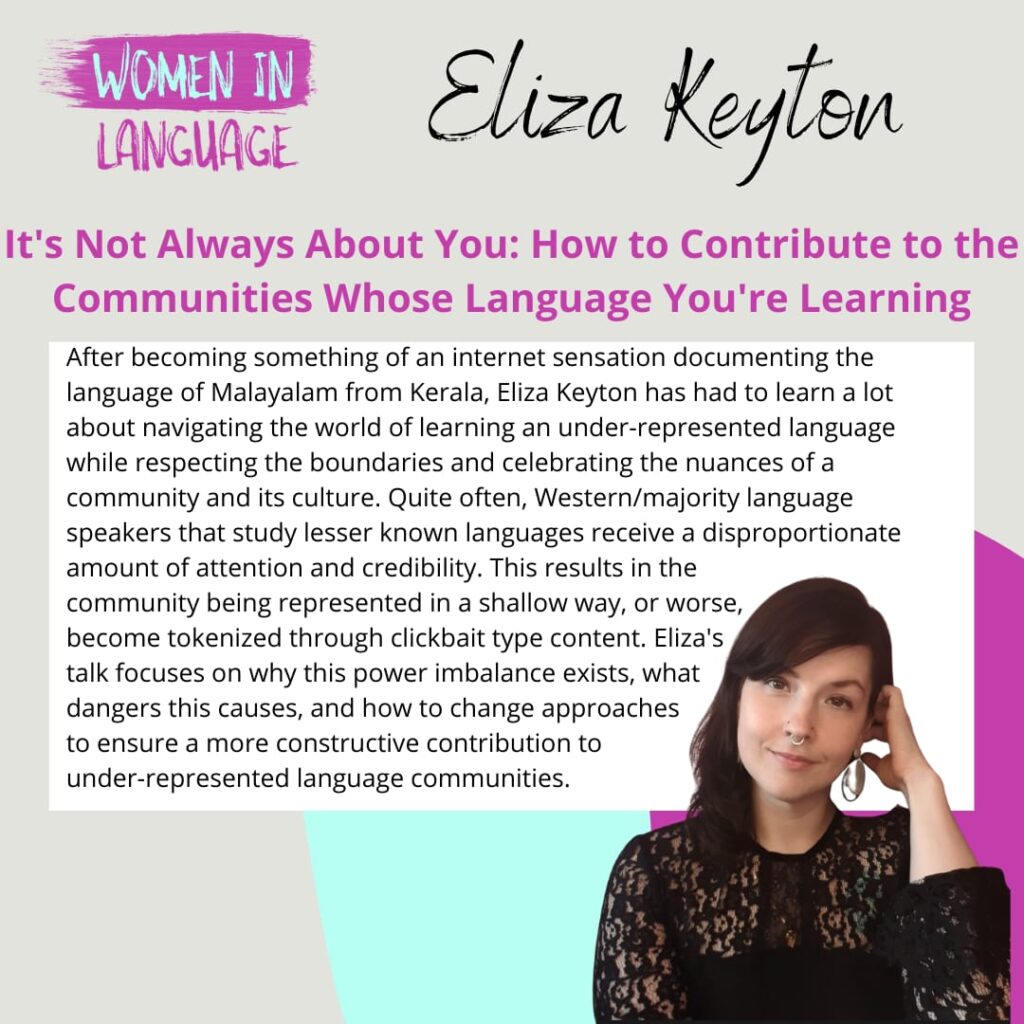
What kind of a linguistic world will your baby grow up in? Am sure it will be rich and varied.
Aside from Malayalam and English, I hope to immerse my child in the language of my stepfamily from former Yugoslavia. I also hope to provide opportunities to learn Spanish and Mandarin, and generally be open to whatever languages we find ourselves surrounded in as we continue working in various places around the world. While I don't expect my child to be fluent in every language he encounters, I hope to instill a sense of respect and openness toward languages and cultures different from his own, and take the time to get to know more about them.