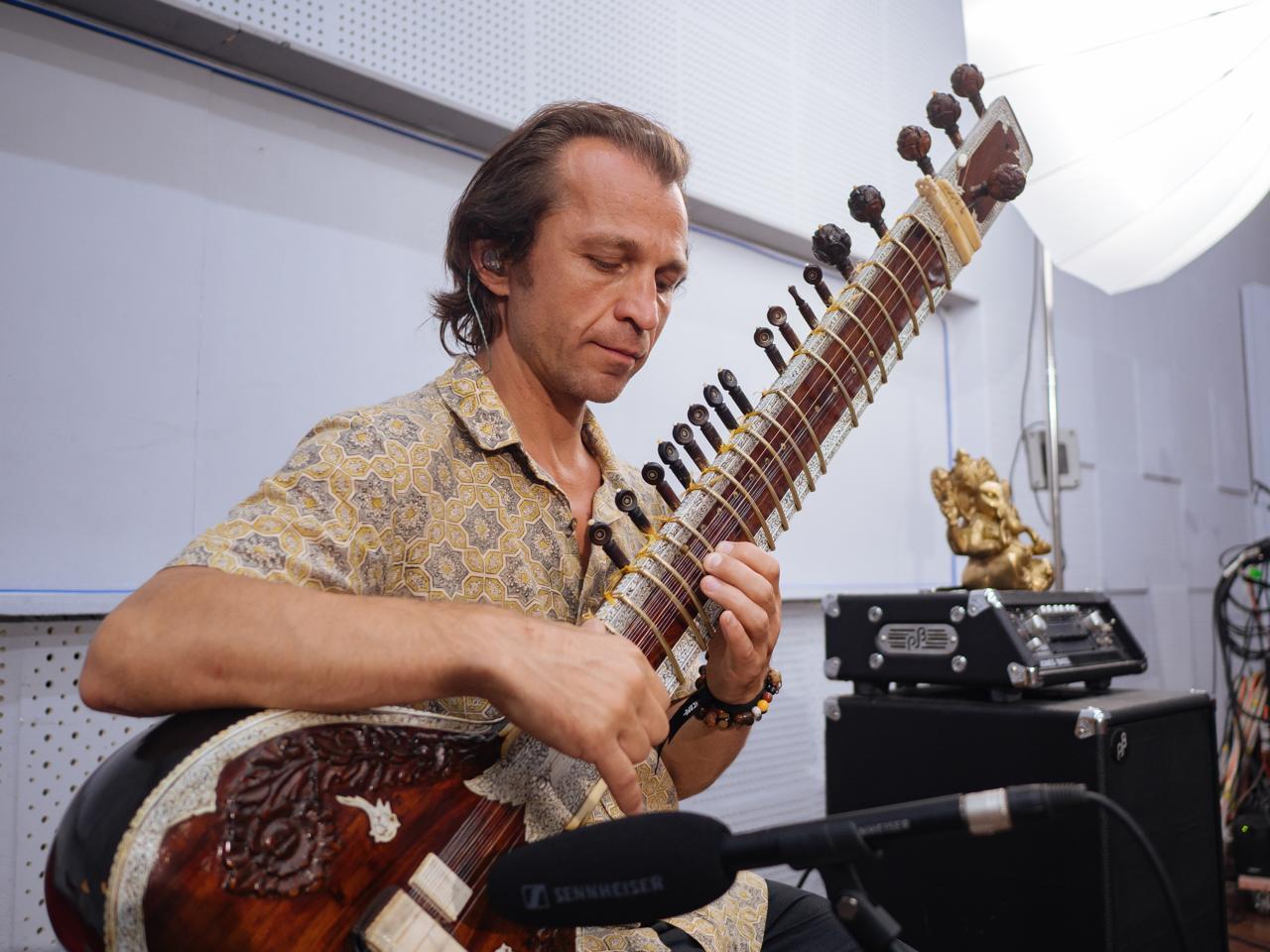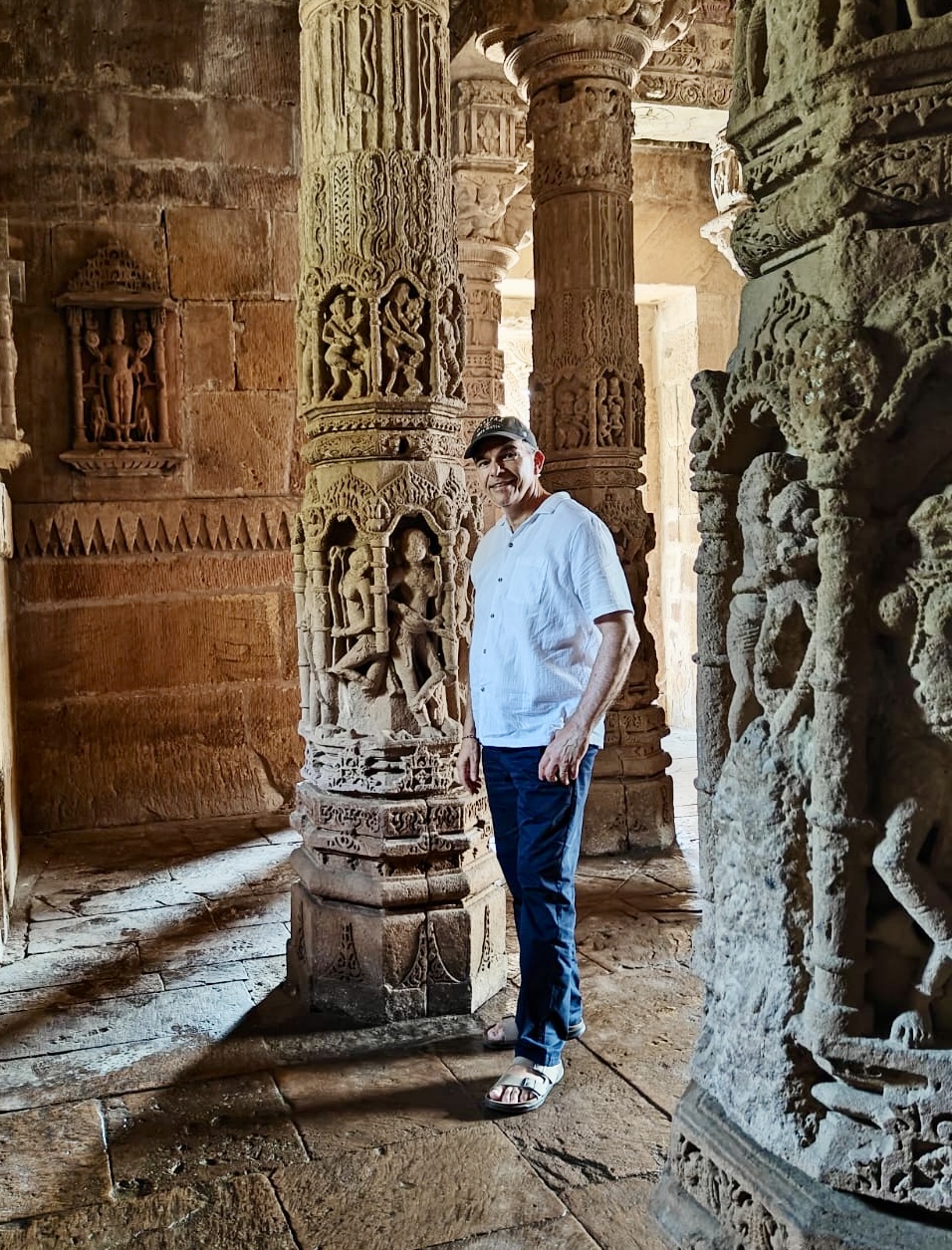


The following essay and a follow up interview with CSP is based on the public talk “Visions of Essence – The Art of Christian de Vietri’s Trika Mandala Prakāśa”, a conversation between Christian de Vietri and Lawrence Rinder moderated by Prof Emily Pott. The discussion provides the interpretive framework for understanding both the scholarly and artistic dimensions of de Vietri’s reconstruction of Trika mandalas, situating the project within the broader history of Kashmir Śaivism, contemporary art practice, and living tantric transmission.
The Trika is a non-dual Śaiva tradition that flourished in medieval Kashmir and may be understood as a systematic science of consciousness. It advances not merely speculative metaphysics but practical disciplines aimed at self-realization. Its central aphorism, Chaitanyam Ātmā - consciousness is the Self - asserts that consciousness is the ontological ground of reality. In contrast to materialism, which treats consciousness as emergent from matter, Trika maintains that matter arises within consciousness.
All Trika practices orient the aspirant toward pratyabhijñā (recognition) of unbounded awareness as one’s true identity. Liberation is not the attainment of something new but the recognition of what has always already been the case. While ritual, mantra, and yogic techniques are included, they are subordinated to the higher aim of immediate non-dual realization. This is expressed in the teaching of śāmbhavopāya, articulated by Abhinavagupta, in which realization occurs through direct insight rather than gradual accumulation. Even explanatory triads - knower, knowing, known; will, knowledge, action -are pedagogical devices that ultimately resolve into unity.
The term “Trika” (“triad”) refers to the goddesses Parā, Parāparā, and Aparā and to the broader triadic logic structuring its metaphysics. Unlike renunciate traditions, Trika affirms worldly life as the dynamic expression of consciousness rather than illusion.
The tradition is preserved chiefly in Abhinavagupta’s Tantrāloka. Following the thirteenth-century decline of institutional support, manuscripts survived among Śaiva families and were later published under Maharaja Pratap Singh in the Kashmir Series of Texts and Studies. In the twentieth century, Swami Lakshman Joo preserved its oral transmission, sustaining the living tradition.
It is within this context that Christian de Vietri - artist, researcher, and author of the present book - situates his work. Having first encountered Trika Śaivism approximately thirteen years prior in the presence of an authentic teacher, de Vietri describes the experience as transformative and destabilizing, dissolving prior metaphysical assumptions while intensifying an inner luminosity. Over time, sustained study and practice revealed to him that a significant visual dimension of the tradition had effectively gone dormant. While the textual and oral transmissions endured, the operative mandalas described in Chapter 31 of the Tantrāloka had not been actively reconstructed in complete and usable form.
In Trika, the mandala is a multivalent term. It may mean circle, disk, zone, or region. This breadth reflects its dual function as both symbolic diagram and operative ritual instrument. Practically, a mandala is a geometric diagram drawn on the ground in colored powders for initiatory purposes. Symbolically, it maps the inner landscape of consciousness, organizing space so that the sacred becomes inhabitable. Its structure is internalized through visualization and mapped onto the practitioner’s body, reordering perception and embedding an elevated metaphysical vision directly into awareness. The mandala thus functions as a gateway: through seeing, one comes to know who one truly is.
Beyond symbolism, mandalas are constructed according to precise grids with exact orientation. Establishing such a grid on the ground aligns the practitioner with an invisible cosmological lattice extending infinitely in all directions, analogous to Indra’s Net. Contact with this matrix is understood to produce harmonization: the intrinsic qualities of pure being—freedom, bliss, wholeness—are recognized as one’s own. This geometric principle parallels temple construction according to VāstuŚāstra; the temple may be understood as a three-dimensional extrapolation of the same grid that structures the two-dimensional mandala.
De Vietri’s project centers on reconstructing these mandalas through rigorous philological and geometric analysis. Chapter 31 of the Tantrāloka contains detailed yet encoded descriptions of multiple mandalas, including the Trident Lotus Mandala. Earlier attempts to render these diagrams include the work of RanierNoli (1972), Alexis Sanderson (1986), and Judith Torzog (2003). Christian de Vietri acknowledges these contributions with respect while arguing that they remain incomplete. Moreover, three additional mandalas long regarded as indecipherable are presented in full sequence for the first time in his book.
The reconstruction required translating Sharada-script Sanskrit, decoding numerical systems such as bhūta-saṃkhyā in which words encode numbers, and situating each instruction within an overall geometric logic. For example, a verse specifying the distance from the base of a trident to the center of a pedestal uses encoded references to “sky” and “oceans,” yielding a measurement of forty angulas. Such passages demand not only linguistic precision but structural comprehension.
In one instance alone - the dimension of the trident’s bulb - de Vietri included an element not explicitly described in the extant verses. This decision was based on structural necessity and comparative analysis with parallel trident forms. He documents this intervention transparently in the notes accompanying the sequence. In other cases, cross-referencing earlier tantras such as the Mālinīvijayottara Tantra revealed verses omitted in Abhinavagupta’s quotation, including one specifying color schemes essential to accurate reconstruction. The process thus involved a balance of textual fidelity, intertextual comparison, and disciplined interpretive judgment.
In traditional Indic contexts, originality for its own sake is not valorized; continuity of transmission is paramount. Yet Abhinavagupta also describes the saṃsiddha guru, a spontaneously realized master consecrated directly by divine consciousness. This model allows for revelation within continuity. Abhinavagupta further asserts that texts themselves function as vehicles of liberation: the awakened consciousness crystallized in writing may be reactivated by future readers. De Vietri understands his work not as innovation but as participation in this ongoing transmission.
The project therefore stands at the intersection of scholarship, artistic reconstruction, and lived spiritual practice. Its aim is not aesthetic reinterpretation but restoration of operative ritual diagrams capable of use. Indeed, qualified Trika teachers have begun employing the reconstructed mandalas, and the Ishwar Ashram founded by Swami LakshmanJoo has acquired the book, suggesting reintegration into the Kashmiri lineage.
Beyond the historical reconstruction, Christian de Vietri reflects on his position as a contemporary artist working within secular contexts. He distinguishes between tantric art, which functions as ritual instrument within a lineage, and tantra-inspired art, which draws from its metaphysical principles within broader cultural frameworks. Public art operates within pluralistic state systems that restrict overt religious assertion, yet the human desire for transcendence persists. Minimalism and abstraction provide languages capable of expressing universal structures without sectarian symbolism.
His public work Spanda, created for Elizabeth Quay in Western Australia, embodies the Trika concept of primordial pulsation - the dynamic vibration through which consciousness manifests as world. No traditional mandala exists specifically for this concept, so de Vietri developed a form informed by Trika principles while remaining accessible within a secular civic space.
Comparisons with modern abstraction raise questions of archetypal convergence, yet de Vietri resists pressures to modify sacred iconography for contemporary market expectations. In recounting a conversation with a gallerist who suggested introducing subversion into an icon of Matsyendranath, he explains that the absence of egoic signature - the disappearance of the authorial “I”- is intrinsic to the work’s integrity. Sacred reconstruction aims not at self-expression but at liberation from limited identity.
The book itself functions as more than documentation. De Vietri conceived it as an operative object, an interstitial medium between textual source and ground-based mandala. One section operates as a flipbook, animating cosmological manifestation into geometric form. In this sense, the book is an artwork designed to empower further artworks—providing precise measurements, orientation instructions, and procedural clarity sufficient for ritual reconstruction.
Reflections on Trika Maṇḍala Prakāśa
Interview with Christian de Vietri by Aparna M Sridhar in light of his book Trika Maṇḍala Prakāśa: Illuminating the mandalas of Abhinavagupta's Tantrāloka (2024), and in response toVisions of Essence - The Art of Christian de Vietri’s Trika Mandala Prakas a (2026), a dialogue between de Vietri and Lawrence Rinder hosted by the King’s Foundation.
What specific ritual procedures “activate” a mandala beyond its geometric construction?
Before we ask what ‘activates’ a maṇḍala, it helps to ask why it is being made. In a classical initiatory context, where a maṇḍala is constructed for dīkṣā (initiation), the process begins well before any geometry is drawn. Traditionally, an aspirant is first assessed through śiṣyaparīkṣā (tests of the student) to determine adhikāra (readiness and suitability). This is followed by purificatory disciplines, vows, and commitments. These preparatory procedures are not decorative add-ons; they are ways of honouring and stabilising the inner transformation the rite is meant to catalyse.
A maṇḍala may also be created for other purposes. For example, the final maṇḍala discussed in my book, the Sky-Lord SvastikaMaṇḍala, is associated with the consecration of a new guru. In each case, the ritual ‘activation’ is tailored to the intended function.
In Trika Maṇḍala Prakāśa, I focus primarily on maṇḍalavinyāsa (construction). However, I also outline the procedures that frame the construction and make it ritually operative: selecting an appropriate place and time, preparing and orienting the ritual field, consecrating the ground, and removing what does not belong—in other words, establishing the conditions in which the maṇḍala can do the work it is designed to do. Once the maṇḍala is complete and the participants are prepared, the ‘activation’ proper typically takes the form of maṇḍalārādhana (worship of the maṇḍala): a sequence of invocations, offerings, and contemplative identifications in which mantra and mudrāare fused with the diagram so that it functions not merely as an image, but as a consecrated vessel and field of encounter.
Is there a systematic explanation in Trika texts of how bodily contact with the grid produces transformation? Is this symbolic, energetic, or metaphysical?
As far as I can see, a systematic explanation of how bodily contact with the grid produces transformation is articulated more explicitly in Śilpaśāstra and allied Vāstu traditions than in the Trika ritual literature itself. In other words, there are different ‘technologies’ at play within a maṇḍala: one concerns the generation of form (how a diagram is brought into manifest order), another concerns the ritual use of form (how a diagram is approached, entered, worshipped, and internalised), and a third concerns the transmission of practice that occurs between guru and disciple at the interface of making and use.
The Tantrāloka is extraordinarily rich on philosophy, contemplative method, and ritual procedure, but it does not, in my reading, provide a sustained treatise on the Śilpaśāstric ‘science of making’—the formal and ontological rationale by which measure, proportion, and grid become a vehicle for embodied transformation. That said, the principle is not merely ‘symbolic’ in the modern sense. In the Śilpa and Vāstu worldview, the grid is treated as a real ordering of space: a way of aligning the body, mind, and awareness with a deeper pattern of manifestation.
My own account of this comes through the oral and textual transmission of my Śilpa teachers, and I discuss it in Chapter 3 of my book as a foundation for the five Trika maṇḍalas that follow. Chapter 3 sets out the Śilpaśāstric logic that sits behind the grid as an embodied technology, which is then applied to the Trika maṇḍalas I present. In that context, I describe what the oral tradition calls vasturevavāstu—the movement from vastu to vāstu—a dynamic architectonics of the absolute by which the metaphysical transmutes into the physical. The traditional artist trained in Śilpaśāstra learns to create in expressive alignment with that process, and the maṇḍalas are all founded upon its pattern.
Since colour schemes are crucial and sometimes omitted, what metaphysical status do colors have within Trika cosmology?
Colour, as a quality of sight, plays a distinctive role in maṇḍala practice because Tantra is not only conceptual. It is deliberately multi-sensory. I would not equate this with the involuntary neurological condition of clinical synaesthesia, but it is reasonable to describe Tantric ritual as a cultivated cross-sensory integration, in which sound, form, gesture, fragrance, and offering are designed to cohere into a single field of experience. In that setting, colour is not ‘decoration’. It is one way in which the ritual field is qualified—made intelligible and effective for inner transformation.
A simple example is how a mantra (a sound) corresponds to a deity (a form). Inner sight and sound are combined in this way, so, effectively, you may see a sound and speak an image. In initiation and worship, this relationship is intensified: mantra may be recited into (or over) the maṇḍala, the maṇḍala is seen and approached as a living presence, and mudrā seals or ‘codes’ the body into the rite. In that sense, the sensory domains are intentionally fused so that the practitioner can recognise their shared origin in consciousness, rather than treating them as separate, self-sufficient channels.
Metaphysically, then, colour in Trika-oriented maṇḍala practice functions as a precise signalling system within a larger technology of embodiment and recognition. It can indicate strata of experience (outer to inner; gross to subtle), and it can differentiate powers, thresholds, and presences within a single diagram. Importantly, colour meaning is context-dependent: the same colour can carry different emphases depending on its placement, the deity involved, and the rite being performed. This is one reason colour schemes can look ‘fixed’ in one setting and ‘variable’ in another.
Many tantric systems also work with a central triad of colours—often white, red, and black—correlated with the guṇas (sattva, rajas, tamas), which are states of consciousness at varying densities. I would frame this cautiously, though: while these associations are widespread, their exact application can vary between lineages and ritual manuals. Likewise, some traditions map colours onto the five elements, but the specific assignments are not always consistent across sources and communities.
In Trika Maṇḍala Prakāśa, each maṇḍala is presented in full colour so that the chromatic logic can be read alongside the measurements and function, rather than treated as optional ornamentation.Within the Trika maṇḍalas I present, the most decisive chromatic signature is probably the triad of the goddesses themselves—Parā (white), Parāparā (red), and Aparā (dark red)— whose colours are not merely symbolic labels, but part of how their powers are contemplated externally in the diagram and internally in visualisation. In other words, colour participates in the discipline of sādhanā, helping the practitioner recognise the spectrum of consciousness as it appears as form and then returns to its source.
A maṇḍala can be read as a map of our own experiential structure, coded by colour. At its centre is the bindu, and at its perimeter the outer wall with its gates. The perimeter corresponds to the outward-facing thresholds of life—the movement of attention towards objects, relationships, and the world disclosed through the senses. The bindu, by contrast, imagesthe self-luminous centre of awareness: the autonomous cognising subject.
Between these two poles, there is a constant oscillation. Consciousness ‘pours out’ through the senses into multiplicity, and then can be recollected inward into its source. From this perspective, ‘knowing the Self’ is not merely adding a belief, but reversing the ordinary direction of attention: returning from the periphery to the centre.
Yet in the Trika, liberation does not end at the centre-point. Many traditions describe an inward ascent to a final stillness; Trika insists on something further: the reintegration of that recognition back into ordinary life. This is why Tantra is often glossed as a ‘weaving’: not a flight from the world, but the reweaving of recognition through the whole fabric of lived experience. Realisation is not only to arrive at the bindu, but to allow the bindu to permeate the whole field—to see the world as an expression of the same consciousness that knows it.
How long were ground mandalas traditionally maintained before dissolution, and what is the doctrinal significance of their erasure?
Traditionally, a ground maṇḍala is maintained for the duration of the rite it is made to serve, whether that is a single session, a full day, or a multi-day sequence. It is not intended as a permanent artefact. Once the ritual is complete, the maṇḍala is ritually ‘withdrawn’ (dissolved, dispersed, or otherwise deconsecrated) as part of closing the rite.
Doctrinally, that erasure is not simply an aesthetic gesture; it marks the transition from a consecrated field back into ordinary space. The maṇḍala is established as a ritually charged ‘body’—a locus for invocation, worship, and transformation—and then it is deliberately released so that its potency is not left lingering in an uncontrolled or ambiguous way. In Trika contexts, this often aligns with two concerns: preserving the integrity of the rite (so its power is not dispersed or appropriated outside its intended frame) and preserving discretion around initiatory technologies that are not meant to be encountered without preparation.
Abhinavagupta also makes practical observations on the disposal of ritual materials (including those associated with maṇḍala work), recommending release into running water as an appropriate means of dispersal. He makes the somewhat odd but poignant comment that it’s ok to feed it to underwater beings because they are already initiates of the siddha Matsyendranāth, Lord of the Fishes. The underlying rationale is consistent: the maṇḍala should function in its liberative, initiatory capacity, and then be withdrawn so it does not become an object of confusion, superstition, or misuse when removed from its proper ritual container.
There is a more widely known emphasis in some Buddhist settings on dissolving sand maṇḍalas as a contemplative teaching on impermanence and non-attachment. Trika does not typically foreground that didactic theme in the same way, although the experience may still have that effect. The Trika emphasis is more on containment, correct closure, and the protection of potency than on making a public pedagogical statement about transience.
If mandalas fell out of use, what doctrinal consequences did this have for the integrity of the initiation system?
This is a difficult question, and it cannot be answered with complete certainty, because ‘Trika’ is not a single, unbroken institutional system with one continuous public record. My book is specifically concerned with Trika maṇḍalas as described in Abhinavagupta’s formulation of the Anuttara Trika, not with every maṇḍala tradition across South Asia.
With that said, if a tradition’s maṇḍala-based initiations fall out of use, the doctrinal consequences are unlikely to be a simple ‘collapse’. Traditions adapt, fragment, and reconfigure. In the Kashmiri context, Alexis Sanderson has argued that what persisted into the modern period was, largely, a gnostic and exegetical Trika—a living emphasis on doctrine, interpretation, and contemplative realisation—while the full ritual repertoire described in works such as the Tantrāloka was no longer widely practised as a complete system. In practical terms, that kind of shift would tend to move the centre of gravity from initiatory liturgy and ritual towards philosophy, textual transmission, and direct contemplative approaches.
However, it would be misleading to equate ‘decline in Kashmir’ with ‘loss of Trika’. Trika teachings, deities, and methods travelled and were recontextualised beyond Kashmir, and Trika elements were also taken up within other tantric ecologies (sometimes explicitly, sometimes by assimilation). The consequence is not a single line of rupture but a complex history of continuity through transformation.
So, if we speak about ‘integrity’ of the initiation system, I would frame it this way: the loss (or attenuation) of maṇḍala practice can mean the loss of a particular initiatory technology of embodiment—a way of joining doctrine to space, form, and consecrated action. What often remains—and sometimes becomes even more emphasised—is the Trika’s interior discipline: the primacy of recognition, lived realisation, and the transmission of understanding. My own work sits within a contemporary moment where a process of reintegration and revival is underway, drawing on both textual evidence and living lineages, while also honestly acknowledging the historical discontinuities. One purpose of Trika Maṇḍala Prakāśa is to make the maṇḍala dimension of the Trika legible again—not as nostalgia, but as a recoverable initiatory technology embedded in Abhinavagupta’s synthesis.
If modern abstraction independently mirrors tantric geometry (e.g., parallels with Agnes Martin), does this support archetypal universality or convergent formal reduction?
There have certainly been curatorial and critical attempts to place Tantric diagrams alongside modern and contemporary abstraction, precisely because the surface affinities can be striking— grids, symmetry, repetition, restraint. Agnes Martin is often brought into this conversation because her work makes the grid feel contemplative rather than merely structural.
That said, I would be cautious about drawing a single metaphysical conclusion from a visual parallel. Two things can be true at once. First, there is a plausible case for convergent formal reduction: when artists in different contexts pursue clarity, concentration, and the minimisation of narrative, they may independently arrive at geometry as a ‘least-noisy’ carrier of attention. In that view, the resemblance tells us something about perception, cognition, and the logic of making, without requiring a shared doctrine.
Second, the history is not purely ‘independent’. The very fact that Western audiences and artists have repeatedly been shown Tantric drawings—through books, exhibitions, and reproductions—means that later parallels sometimes occur within an environment of indirect contact, even if that contact is diffuse and unacknowledged. For example, the Rajasthani Tantric paintings associated with Franck André Jamme entered broader circulation through his collecting and publications, which explicitly prompted comparisons with modern art. Curatorial projects have also directly invited contemporary artists to respond to Tantric drawings.
So, rather than choosing between ‘archetypal universality’ and ‘formal convergence’, I would answer like this: geometry can be a shared visual endpoint, but the works remain ontologically and instrumentally different. Tantric maṇḍalas (and related diagrammatic forms) are typically conceived as operative technologies—they are made to be used within a disciplined ecosystem of initiation, worship, and contemplative identification, often outside public display. By contrast, modern abstraction, including Martin’s, is generally designed to function within the exhibitionary and discursive frame of the art world, where meaning is negotiated through aesthetic experience, criticism, and institutional context.
In short, we may observe a visual rhyme, but the works are oriented towards different destinations: one towards ritual efficacy and liberation, the other towards aesthetic contemplation and the conditions of viewing. The resemblance is real—but it does not, by itself, collapse these into the same category.
Is the mandala grid identical to Vāstu Puruṣa Maṇḍala principles, or are there doctrinal divergences? Can a mandala retain ontological efficacy in a secular gallery setting absent shared metaphysical belief?
On the first question: Śilpaśāstra posits that the fundamental pattern of the absolute is the 8 by 8 grid referred to as the maṇḍūka-maṇḍala (the Leaping Pattern), and the pattern of the relative is the 9 by 9 grid referred to as the paramasāyika-maṇḍala (the Resting Pattern). Perceived reality is the result of an infinite transmutational pulsation between these two, the subtle and the gross, sūkṣmatosthūla. All maṇḍalas, regardless of the doctrine they serve, tend to be built upon either one of these grids, the 8 by 8 or the 9 by 9, or multiples of these two.
On the second question: a maṇḍala could theoretically retain its ontological efficacy in any setting, to a meaningful degree, because its efficacy in the Śilpaśāstra frame is not dependent on shared metaphysical assent so much as on the work’s repeatable, perceptible functioning. Its proportional ‘grammar’ and spatial ordering operate as a technology of attention that can concentrate awareness and generate a recognisable charge even for viewers who do not ‘believe’ the underlying doctrine. That said, if a maṇḍala was simply presented as a form by itself, I think that what would be retained in a secular gallery is likely a partial efficacy: the experiential and perceptual force can remain verifiable, while the fuller ontological claims may be attenuated without the supporting ecology of intention, practice, and ritual context. So the question becomes not as much about belief or no belief, but which layers of efficacy a particular setting can sustain. The process of site-selection is precisely detailed in Śilpaśāstra, and I’ve dealt with this in a chapter toward the end of the book. A maṇḍala could theoretically be installed in many different locations, but I think we cannot and should not attempt to divorce the maṇḍala as a form from the function it was designed to serve.
If the book is “operative,” what are the minimal conditions required for it to function ritually rather than academically?
My book presents illustrated, step-by-step sequences for configuring the Trika maṇḍalas, and in that sense it can function as a practical manual for their construction—not only an academic study. I intentionally frame the material in two registers: one legible to contemporary scholarship, and another that stays close to śāstric conventions and the internal logic of the tradition. That dual framing is meant to support both understanding and legitimate application.
If we ask what the minimal conditions are for the book to function ritually rather than only academically, I would put it like this. First, it requires right orientation and intention: the maṇḍala is approached as an operative technology, not as an aesthetic motif or historical curiosity. Second, it requires basic procedural containment: a suitable time and place, a prepared field, and a disciplined approach to measurement and execution—because the work depends on precision, not expressive improvisation. Third, it requires a living context of practice to become fully itself. A reader can learn a great deal from the book—especially the sequence, measurements, and formal logic—but in living traditions the craft of construction itself is ordinarily refined through guru–śiṣya transmission. And the further ritual layers of maṇḍala work—consecration, worship, initiation, and transmission—likewise depend on instruction received within the guru-disciple relationship and lineage.
So, the book can genuinely function as an operative guide at the level of configuration and craft. For it to function as a complete ritual engine, it needs to be taken up within the wider ecology of practice that maṇḍalas were designed to serve. In that sense, the book is a bridge: it preserves a precise technology of form and makes it available, while remaining honest about what a book alone can and cannot replace.
Would a digitally rendered mandala possess the same alignment efficacy as one physically inscribed on consecrated ground?
A digitally rendered maṇḍala, including the ones illustrated in my book, can certainly have a real perceptual and contemplative effect. The proportional order, the internal symmetry, and the way attention is gathered and stabilised can still be experienced by a viewer on a screen or a page. A representation of a maṇḍala can also effectively encode and convey a tradition’s teachings.
But it does not operate in the same way as a maṇḍala that is physically constructed to specification within a prepared and consecrated field for a defined rite. In traditional use, the maṇḍala is not only an image; it is an enacted ritual environment. Its efficacy depends not just on appearance but on embodiment: the labour of precise construction, the handling of materials, the orientation of the space, the presence of participants, and—in initiatory contexts —the living procedures that ‘install’ and ‘withdraw’ the maṇḍala as part of a complete cycle.
So I would say: the digital form can carry a strong visual and cognitive efficacy, but the full alignment efficacy of a consecrated ground maṇḍala is typically thickerbecause it includes physical inscription, situated time and place, and the ritual ecology that makes the diagram function as more than a representation.
The simplest way to put it is: the blueprint is not the building. Or, to use a Tantric analogy: reading a mantra can communicate meaning, but reciting it as a disciplined practice is what makes it come alive.
In summary, the Trika articulates a radical non-dual vision: consciousness as the sole ground of reality, the world as its dynamic expression, liberation as recognition rather than acquisition. The mandala serves as geometric crystallization of this metaphysics, embedding doctrine into space and body. Through disciplined philology, geometric rigor, and sustained spiritual practice, Christian de Vietri’s work seeks to restore a dormant visual technology within a living lineage - reuniting scholarship, art, and realization in the service of a tradition whose central insight remains that consciousness alone is the Self.
Link to the book:
https://www.amazon.com/dp/1763555321/