
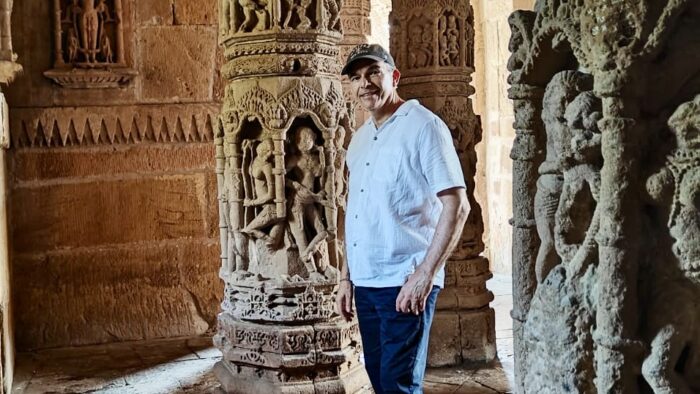
The signing of a research contract between Banaras Hindu University and Griffith University marks a major step toward strengthening global research on human evolution. BHU is now a core partner in a $ 85 million global reserearch initiative led by Griffith University. At the heart of this collaboration is Professor Michael Petraglia, Director of the Australian Research Centre for Human Evolution at Griffith University, whose association with India spans nearly forty years and whose work has reshaped how India is understood in global prehistory.
Professor Petraglia first came to India in the late 1980s, following an academic encounter that would define the course of his career. At the time, he was pursuing doctoral research at the University of New Mexico when he met the renowned Indian archaeologist Professor K. Paddayya of Deccan College. That meeting led to an invitation to collaborate on archaeological research in the subcontinent.
“My first visit to India was in 1988,” Petraglia recalls. “That visit really set in motion my lifelong association with India and its archaeology.”
Before arriving in India, Petraglia’s travel experience had been largely confined to Western Europe. India, he admits, was a profound cultural shift. “There was a strong dose of culture shock,” he says, “but in retrospect, it taught me an enormous amount about my anthropological interests in cultural diversity and how different people live around the world.”
This early immersion shaped both his personal worldview and his professional approach. During the first phase of his career in India, Petraglia emphasizes, his work was made possible through the support of Indian scholars who opened doors to field sites, collaborations, and research opportunities. “Indian colleagues were incredibly generous in supporting my early work,” he notes.
Over the next two decades, Petraglia conducted joint archaeological projects across India, working consistently in the country from 1988 to 2009. His last field visit to Deccan College, Pune, took place in 2012. Even after that, his engagement did not diminish. From abroad, he continued supervising doctoral students and postdoctoral fellows, maintaining deep academic ties with Indian institutions.
His most recent visit to India coincided with participation in a prestigious Wenner-Gren symposium, where he met Professor Gyaneshwer Chaubey of Banaras Hindu University. That meeting further strengthened institutional links that have now been formalized through the BHU–Griffith agreement. BHU is also a partner institution in the Australian Research Centre of Excellence consortium, which brings together a global network of organizations.
Reflecting on the significance of this partnership, Petraglia stresses that India has long been underrepresented in dominant models of human evolution. “The Indian subcontinent presents an extraordinary diversity of landforms, climates, cultures, languages, and lifeways,” he says. “Yet, for a long time, human prehistory has been framed largely through a European lens.”
He argues that understanding early hominin migration into India requires two essential steps. “First, we need to find well-preserved archaeological sites,” Petraglia explains. “Second, we must apply scientific dating methods to fossils and stratigraphic deposits so that discoveries can be placed in proper chronological context.”
Despite India’s vast size and archaeological potential, the fossil record remains limited. “India has the famous Narmada hominin fossil, which is likely an archaic ancestor,” he points out, “but beyond that, we lack major hominin fossils. This clearly shows the need for new scientific exploration.”
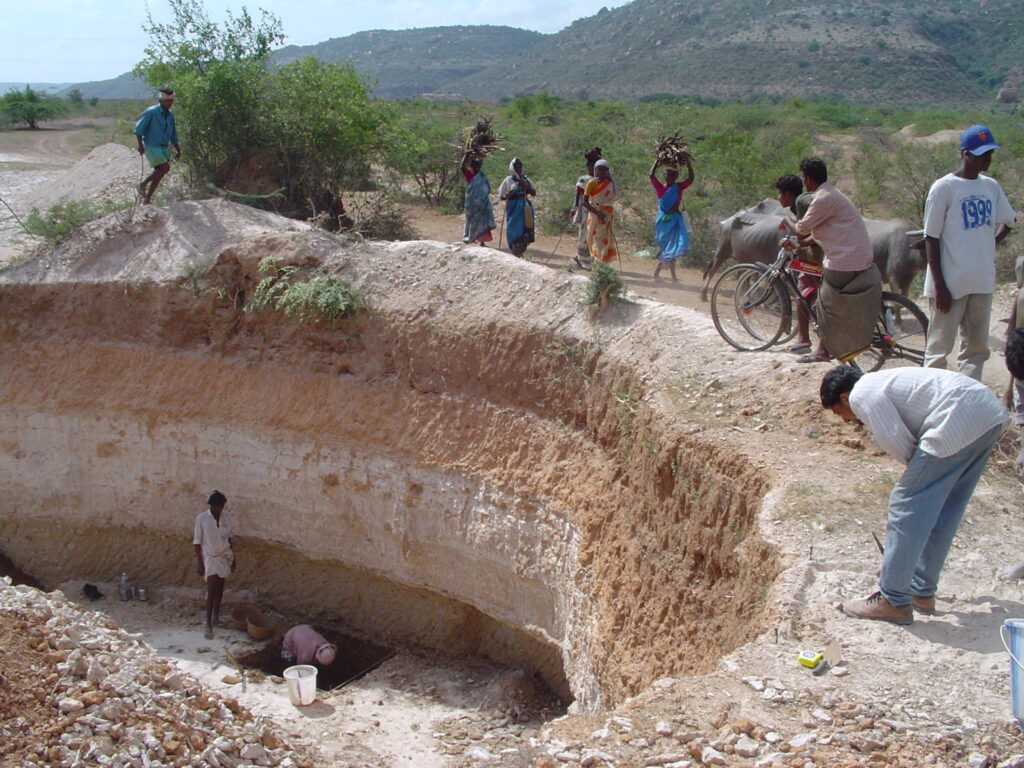
Excavation Jwalapuram under Toba ash
One of the most influential outcomes of Indo-international collaboration has been Petraglia’s work on the Mount Toba super-eruption. While many scholars believed the eruption caused a catastrophic global population bottleneck, Petraglia’s team uncovered a different story. At Jwalapuram in Andhra Pradesh, his team identified the world’s first direct association between Toba volcanic ash and archaeological evidence.
“We published these findings in Science in 2007,” Petraglia says. “And we’ve been involved in debates ever since.”
Subsequent work at another site in northern India, conducted with Professor J. N. Pal of the University of Allahabad, reinforced these conclusions. Similar associations between ash and archaeology were later identified in Africa as well. “The results so far indicate there was no major global catastrophe,” Petraglia explains. “Instead, our research in India shows continuity of people after the volcanic event, even if populations were affected.”
According to Petraglia, this resilience is closely tied to India’s unique environmental setting. “India is a distinct biogeographic zone,” he says, “with its own environmental, vegetation, and animal history.” Humans entering the subcontinent encountered a mosaic of ecosystems shaped by changing monsoon patterns, requiring flexible adaptive strategies.
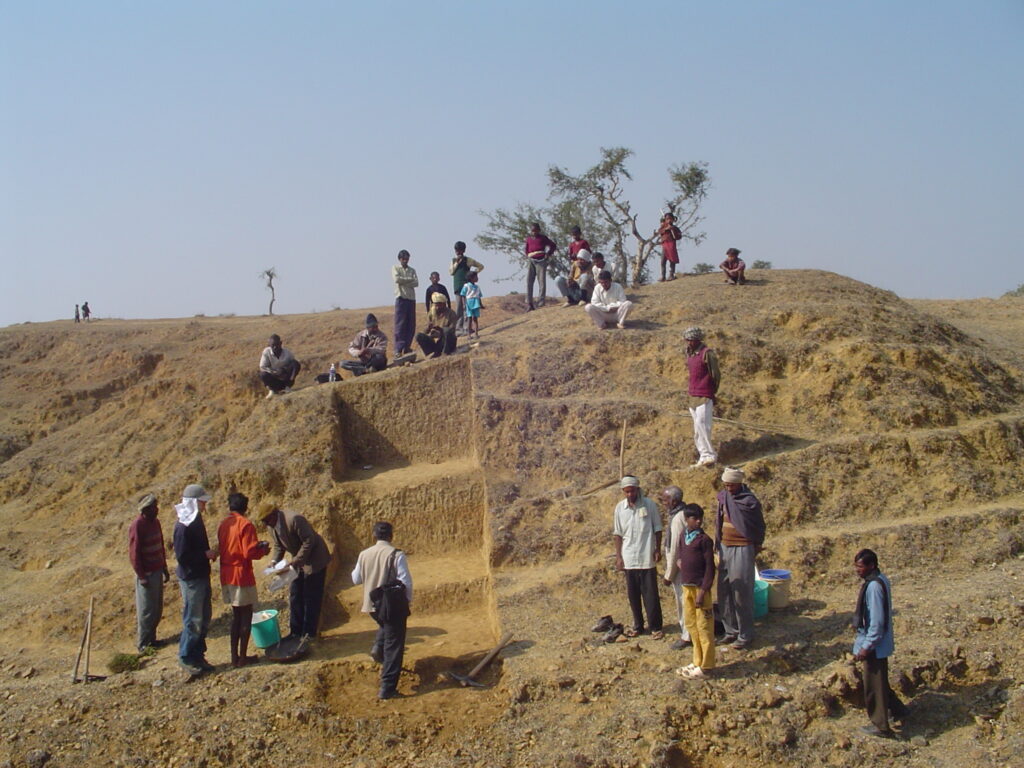 Excavation Middle Son Valley
These adaptations, Petraglia argues, laid the foundations for the cultural diversity seen in India today. Hunter-gatherer societies developed varied ways of life depending on local ecologies, while later agricultural and pastoral communities continued to adapt to specific landscapes and social networks.
Addressing migration routes, Petraglia challenges the dominance of simplistic models. While coastal dispersal along the Indian Ocean rim has been widely proposed, he notes that southern India and coastal regions remain under-studied due to historical research bias and uneven funding. “It’s not just a gap in interpretation,” he says, “it’s also a gap in detailed scientific investigation.”
From a geographic perspective, Petraglia explains that early humans likely entered India through the northwest, crossing regions such as the Thar Desert during wetter climatic phases. His collaborative research demonstrates that these landscapes were periodically greener, making them viable migration corridors. From there, populations moved southward, following river valleys deep into the peninsula.
He also addresses why southern India did not develop large centralized river-valley civilizations comparable to the Nile or Mesopotamia. “Societal complexity took many forms,” Petraglia explains. “India has the remarkable Harappan civilization, but it also had many diverse and complex Neolithic societies across different regions.”
These Neolithic communities adopted agriculture and pastoralism in ways tailored to local environments, later developing unique social and technological innovations rather than centralized urban systems.
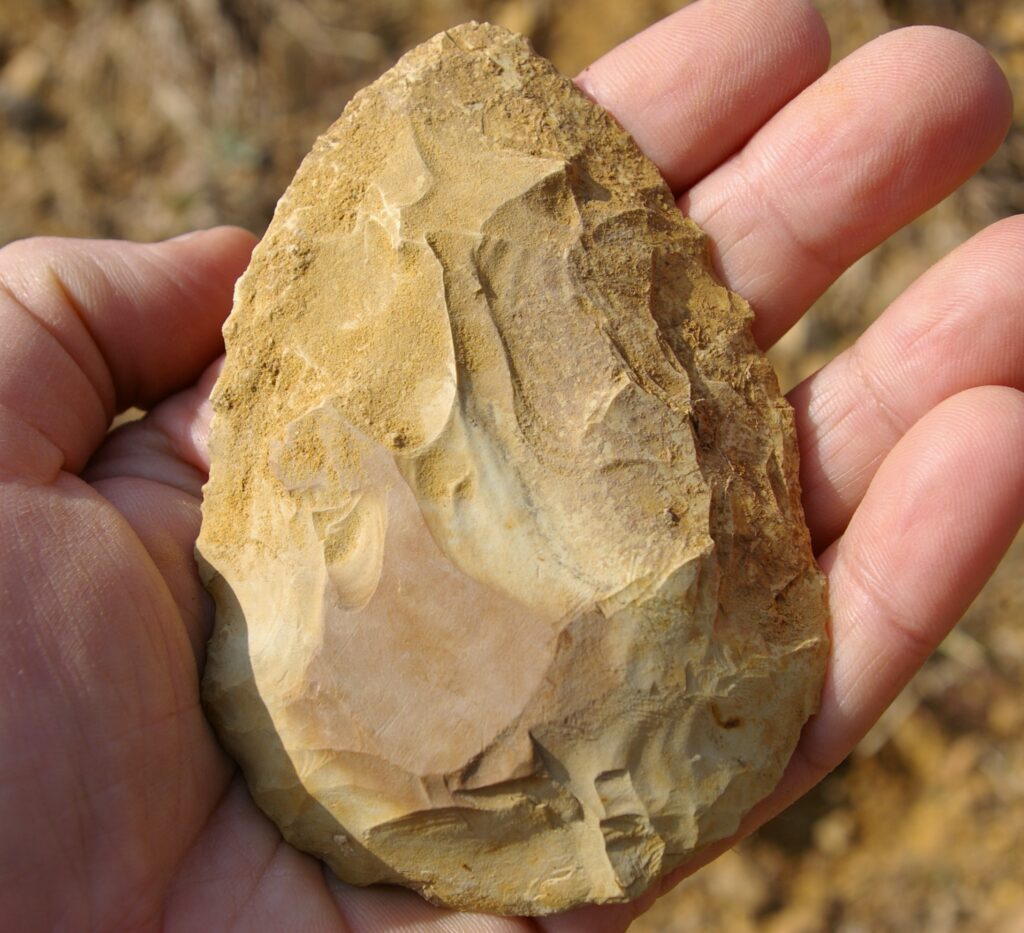 Stone tool
On the biological front, Petraglia highlights differences between hunter-gatherers and later agricultural populations. “Hunter-gatherers were highly mobile,” he says. “Their demanding lifestyle produced strong, robust skeletons, indicating significant musculoskeletal strength.” In contrast, sedentary agricultural populations show increased evidence of disease, malnutrition, and trauma.
Despite India’s immense linguistic and cultural diversity, Petraglia points to an underlying unity. “We are all one species - Homo sapiens,” he says. “While there is unity at that level, there is also biological and cultural diversity shaped by deep history.”
Genetic research suggests that Indian populations have roots extending back at least 50,000 years, and possibly much earlier. Petraglia notes that while Homo sapiens may have arrived in India as early as 200,000 years ago, fossil and ancient DNA evidence is still needed to confirm this. If such early populations existed, they were likely absorbed or replaced by later groups.
As populations became more settled after about 10,000 years ago, hunter-gatherers, pastoralists, and agriculturalists often lived side by side. “It’s this long history of coexistence,” Petraglia explains, “that makes India stand out from many other regions.”
Responding to claims that modern humans arrived late in India despite early cultural sophistication, Petraglia emphasizes the depth of the timeline. “Homo sapiens reached India no less than 50,000 years ago,” he says. “There was a very long legacy of hunter-gatherer societies with advanced technologies, symbolism, and social organization.”
Finally, Petraglia reflects on how changing landmasses, sea levels, and climates shaped migration and settlement. While coastal dispersal theories remain popular, his research shows that inland river systems played a central role. “The archaeological record of India clearly shows that rivers and basins were commonly used,” he says, “rather than coastlines for which we have little evidence.”
For Petraglia, the BHU–Griffith partnership represents both continuity and renewal. “Now that I am a senior researcher and fortunate to have received a major seven-year award, I can provide new opportunities - especially for students,” he says.
By formalizing decades of collaboration, the agreement affirms a shared commitment to uncovering humanity’s deep past - one that places India firmly at the heart of global human evolution research.